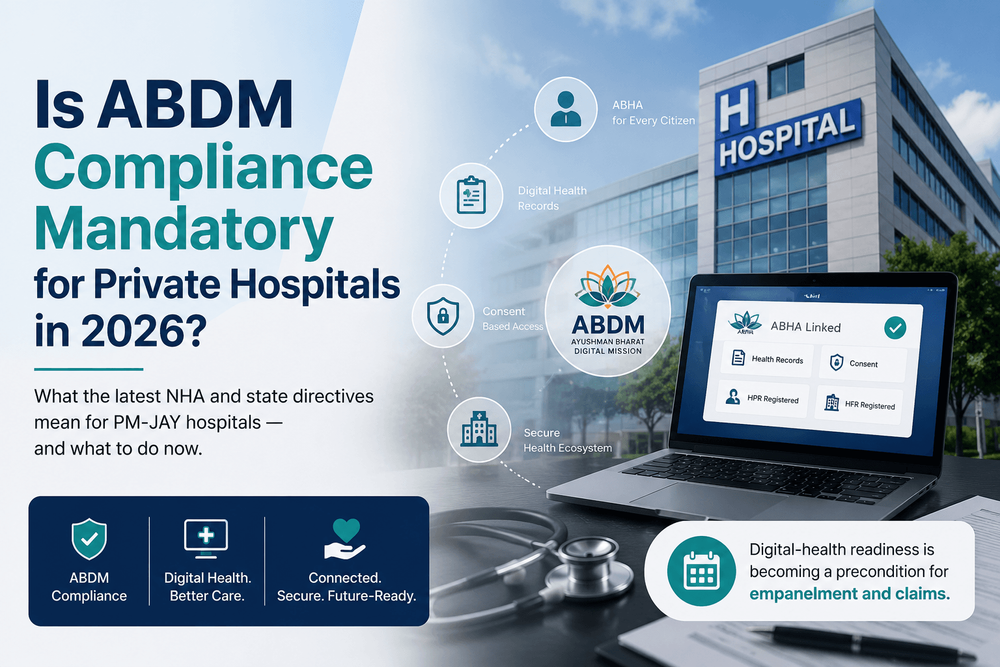
The 7-Step ABDM Compliance Checklist for Hospitals and Clinics
Whether driven by state health mandates, PM-JAY empanelment requirements, or digital modernization, becoming compliant under the Ayushman Bharat Digital Mission (ABDM) follows a defined operational blueprint. Use this checklist to benchmark your facility's readiness.
What ABDM Compliance Means in Practice
At its core, ABDM compliance established by the National Health Authority (NHA) requires three foundational pillars: verified facility registration, authenticated healthcare practitioners, and an interoperable software layer capable of creating, exchanging, and linking longitudinal patient health records under a secure digital consent framework.
The 7-Step ABDM Compliance Checklist
Step 1 — Register Your Facility in the HFR
Enroll your hospital, nursing home, or diagnostic center in the Health Facility Registry (HFR) to generate an official facility ID. This unique identifier links all clinical records, departments, and government scheme claims.
- Facility registered in HFR portal
- Unique HFR facility ID verified
- Operational services, department lists, and physical location updated
Step 2 — Register Doctors and Nurses in the HPR
Enroll all practicing physicians and medical professionals in the Health Professional Registry (HPR). Their State Medical Council registrations are digitally authenticated and mapped to your facility's HFR ID.
- Practicing clinical team registered with HPR IDs
- Doctor credentials linked directly to facility HFR
- HPR onboarding added to new staff recruitment workflows
Step 3 — Adopt ABDM-Certified HMIS / EMR Software
Hospital information systems must achieve milestone certification under NHA criteria. The software must generate FHIR R4 (Fast Healthcare Interoperability Resources) compliant bundles for clinical documentation.
- HMIS/EMR actively certified across ABDM M1, M2, and M3 milestones
- Native support for FHIR R4 schema generation
- Vendor provides verifiable certification status from NHA
Step 4 — Enable ABHA Creation & Scan-and-Share Workflows
Integrate Ayushman Bharat Health Account (ABHA) generation and token identification directly into your front-desk OPD registration counter, avoiding separate external web portals.
- Front-desk generation of ABHA via Aadhaar OTP or mobile auth
- ABHA QR code "Scan and Share" enabled for instant counter check-in
- ABHA numbers linked automatically to the internal patient ID (UHID)
Step 5 — Generate Standardized Digital Health Records
Move away from unstructured scanned PDFs. Clinical notes, diagnostic pathology reports, e-prescriptions, and inpatient discharge summaries must publish as standardized FHIR data bundles.
- OPD consultation summaries structured digitally
- Diagnostic lab, imaging, and prescription outputs standardized
- Inpatient discharge summaries generated in compliant digital formats
Step 6 — Implement the Digital Consent Architecture
Under the ABDM architecture, medical records cannot be shared between providers without explicit patient permission. Your platform must handle electronic consent requests seamlessly.
- Consent artifacts gathered prior to outbound record transfer
- Support for time-bound, purpose-specific, and revocable consent
- Tamper-proof digital consent audit trail maintained
Step 7 — Connect to the Health Information Exchange (HIE-CM)
Connect your facility to the Health Information Exchange & Consent Manager (HIE-CM) as both a Health Information Provider (HIP) and Health Information User (HIU) to enable bidirectional care continuity.
- Configured as a verified Health Information Provider (HIP) to publish records
- Configured as a Health Information User (HIU) to view historical care data
- Interoperable referral data exchange operational
Implementation Timelines: What to Expect
Actual onboarding duration depends primarily on whether your digital foundation is modern or reliant on legacy architecture:
| Hospital Starting Point | Typical Time to Full ABDM Compliance |
|---|---|
| Already using an ABDM-certified HMIS | 3–7 Days: Primarily administrative HFR/HPR verification |
| Using an uncertified system with compliant middleware | 2–4 Weeks: API configuration, testing, and sandbox verification |
| Transitioning from paper or legacy systems to a certified cloud HMIS | 3–6 Weeks: Full data migration, role-based onboarding, and go-live |
Overcoming Common ABDM Implementation Roadblocks
"Our legacy software cannot generate FHIR R4 bundles."
Avoid attempting custom API wrappers on legacy monolithic databases. Instead, implement pre-certified ABDM gateway middleware or migrate to an out-of-the-box certified system.
"Intermittent internet disrupts OPD registration."
Select software with offline caching capabilities, allowing front-desk staff to queue registrations locally and sync ABHA linkages as soon as network stability returns.
"Concerns over transition overhead and compliance costs."
HFR registration, HPR verification, and official NHA sandbox access carry zero government fees. A cloud-based HMIS eliminates local server investments while lowering overhead via faster paperless insurance claim settlements.
How LinkedCare Simplifies ABDM Compliance
LinkedCare eliminates software-side implementation overhead by integrating Steps 3 through 7 directly into daily clinical workflows:
- Certified Out-of-the-Box: Full compliance with NHA milestone standards and automated FHIR R4 schema formatting.
- Frictionless Registration: Instant ABHA creation and QR scan-and-share features built right into the OPD billing interface.
- Automated Clinical Bundling: Consultations, lab orders, voice prescriptions, and discharge summaries format as structured health records without additional manual steps.
- Integrated Consent Engine: Secure, auditable consent management and direct connectivity to the ABDM Health Information Exchange.
For hospital management, this transforms what appears to be a seven-step technical overhaul into simple administrative registrations (Steps 1 and 2), backed by dedicated onboarding support.
Frequently Asked Questions
Do I have to complete the steps in this exact order?
Can I become ABDM compliant without changing my software?
Is there an official government fee for HFR/HPR registration?
Where do I confirm state-specific implementation deadlines?
Accelerate Your Hospital's ABDM Compliance
Discover how LinkedCare automates ABHA registration, FHIR clinical records, and exchange connectivity directly in your existing workflow.
Schedule a Compliance DemoDisclaimer: This checklist reflects National Health Authority (NHA) operational guidelines. Compliance mandates and PM-JAY integration timelines vary by state authority; verify specific state requirements prior to execution.