A practical framework for evaluating clinic management software in India — what to test, what to ask, and which of the questions that decide success never appear on a feature comparison sheet.
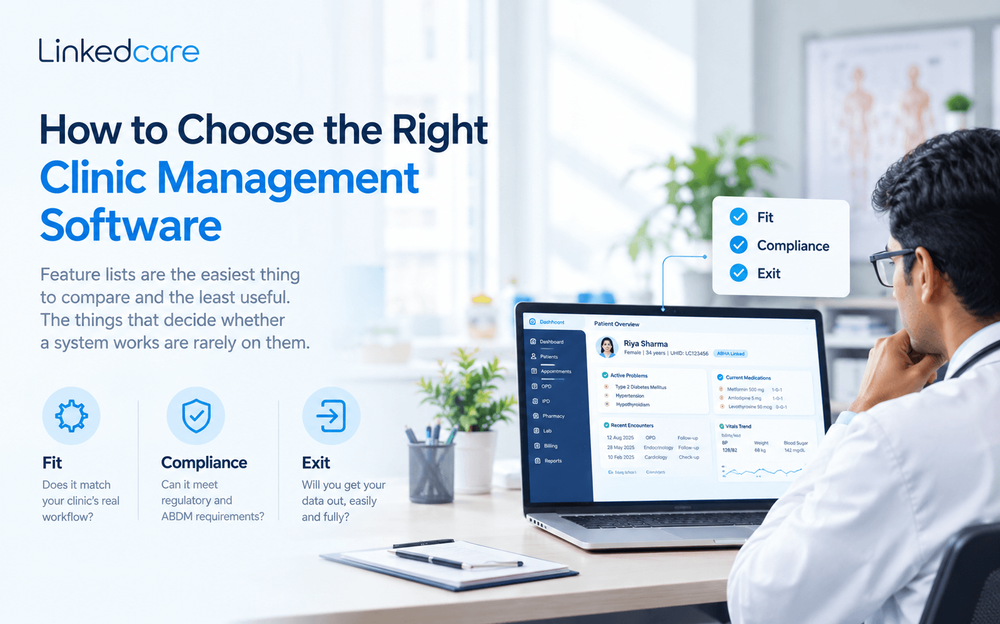
Three questions. Feature lists answer none of them.
Most clinic software evaluations run the same way. Three vendors send a feature matrix, each matrix has more ticks than the last, a demo is watched, a price is negotiated, and a decision is made on the combination of the two. Eighteen months later the clinic is either quietly happy or trapped — and almost nothing in that evaluation process predicted which. The reason is that feature parity is now near-universal at this end of the market. Every serious system does appointments, billing, prescriptions and reports. What differs is fit to your specific workflow, seriousness about regulation, and what happens on the day you want to leave.
Fit
Does the system match how your clinic actually runs — your specialty, your patient volume, your number of locations, your billing model — or does it match a generic clinic that does not exist? A system with every feature and the wrong workflow is slower than paper.
Compliance
Can it handle ABDM linkage, DPDP-grade consent capture, and the documentation an insurer, a PM-JAY audit or an NABH inspection will actually ask for? These requirements are moving, and a vendor's roadmap here tells you more than its current screenshot.
Exit
If you leave in three years, do you get your data out, in a usable structured form, without paying for the privilege? This is the single most-skipped question in healthcare software procurement and the one that costs the most when skipped.
Ten questions to ask before you sign
Who exactly will use this, and what does each of their days look like?
Write the list before the first demo: doctors, receptionists, nurses, cashier, pharmacy, lab. Score every system against each role separately. A system that delights the owner and frustrates the front desk will be abandoned by the front desk, and the front desk is where your patient experience lives.
Ask for a demo of your workflow, not their demo
Send the vendor three real scenarios from your clinic — a walk-in with no records, a follow-up on a chronic patient, an insurance case — and ask them to run those. Scripted demos are optimised to avoid the awkward parts. Your scenarios are the awkward parts.
Test the busiest fifteen minutes, not the average one
Ask how the system behaves with a full waiting room, patchy internet, and two receptionists working simultaneously. Ask specifically what happens when connectivity drops mid-registration. In most Indian clinics this is a weekly event, not an edge case.
Ask what ABDM certification they actually hold
ABDM readiness is not a marketing claim. Ask which milestones the product is certified against, whether ABHA creation and verification are live, whether the system can both send and fetch records through a Consent Manager, and how the consent artefact is stored against the encounter. Ask to see it working on a live patient record.
Ask how consent is handled under DPDP
Whether clinical consent, ABDM consent and data-processing consent are captured as separate, timestamped, granular records or as one bundled tick-box. A single blanket consent line is the pattern most systems still ship with, and it is the one that will not hold up.
Ask where the data is hosted, and who can see it
Data centre location, encryption at rest and in transit, role-based access control, and whether an audit trail records who viewed which record and when. For any clinic that will handle insurer or government-scheme data, the audit trail question is not optional.
Ask the exit question in writing
Can you export the complete patient database — demographics, clinical notes, prescriptions, investigations, documents — in a standard structured format, on demand, at no additional charge? Get the answer in the contract, not in an email. A vendor who hesitates here has told you something important.
Price the whole thing, over three years
Licence plus implementation plus data migration plus training plus per-location and per-user increments plus support tier plus the cost of features quoted as "available in the enterprise plan." Monthly per-user pricing looks cheapest at two users and is rarely cheapest at fifteen.
Ask what support looks like at 9 pm on a Saturday
Response time, escalation path, whether support is by ticket, phone or WhatsApp, and whether there is anyone in your time zone who understands Indian clinical workflow. Also ask how a configuration change gets made after go-live — and whether it costs money each time.
Talk to two customers the vendor did not choose
Ask for a list of clinics of your size and specialty, then pick who you call. Ask them one question above all others: what surprised you after go-live? The answer to that is the part no evaluation process ever surfaces on its own.
What "the right software" actually means in practice
Concretely: the right system is the one where your busiest receptionist can register a walk-in faster than she can write in the register, your doctors can read a returning patient in under a minute, your billing reconciles without a parallel spreadsheet, your ABDM and consent obligations are handled inside the normal workflow rather than as extra work, and you could leave in three years with your data intact.
Notice that only one of those is a feature. The rest are properties of the fit between a product and a clinic — which is why the evaluation has to be built around your own scenarios and your own staff rather than around a comparison table.
The Reality Check: A brief word on the most common mistakes. Buying for the clinic you plan to be in five years usually means paying for complexity you cannot use today; the better test is whether the system can grow without a migration. Choosing on price alone tends to relocate the cost into staff time, where it is larger and invisible. And the single most expensive error is skipping the migration conversation: getting five years of existing records into the new system is a project in its own right, and finding that out after signing is how implementations lose six months.
How LinkedCare helps
LinkedCare is built for Indian clinics and hospitals specifically — ABDM linkage, ABHA creation, consent artefacts, PM-JAY and insurer documentation, and NABH-relevant capture are part of the core workflow rather than modules bolted on for a compliance checklist. Evaluations run on your scenarios: we configure a sandbox with your departments, doctors and tariffs, and let your own front desk and clinicians run their real day through it before any commitment. Data export in a structured, standard format is part of the agreement rather than a negotiation, because a system you cannot leave is not a system you chose freely.
Frequently Asked Questions
Cloud or on-premise for a clinic in India?
Cloud, for almost every clinic under a few hundred beds — no server to maintain, no local backup discipline to enforce, updates handled centrally, and multi-location access without a VPN. On-premise makes sense mainly where connectivity is genuinely unreliable or an institutional policy requires it, and it brings a real IT burden that has to be staffed.
How much should a small clinic expect to pay?
It varies too widely to quote a useful figure, but structure the comparison over three years and include implementation, migration, training, support and per-user growth. The differences between vendors on those lines are usually larger than the difference in headline licence price.
Do we need ABDM integration if we are a small private clinic?
Increasingly, yes — patients arrive with an ABHA and expect their records linked, and integration is a prerequisite for a growing number of scheme and insurer workflows. Even if it is not urgent for you today, choosing a system without a credible ABDM path means facing a migration later rather than an upgrade.
How long does migration from an existing system take?
Typically four to twelve weeks depending on data volume and quality, and the quality matters far more than the volume. Ask any prospective vendor to review a sample export from your current system before you sign, and ask specifically what will not migrate — there is always something, and you want to learn it before the decision rather than after.