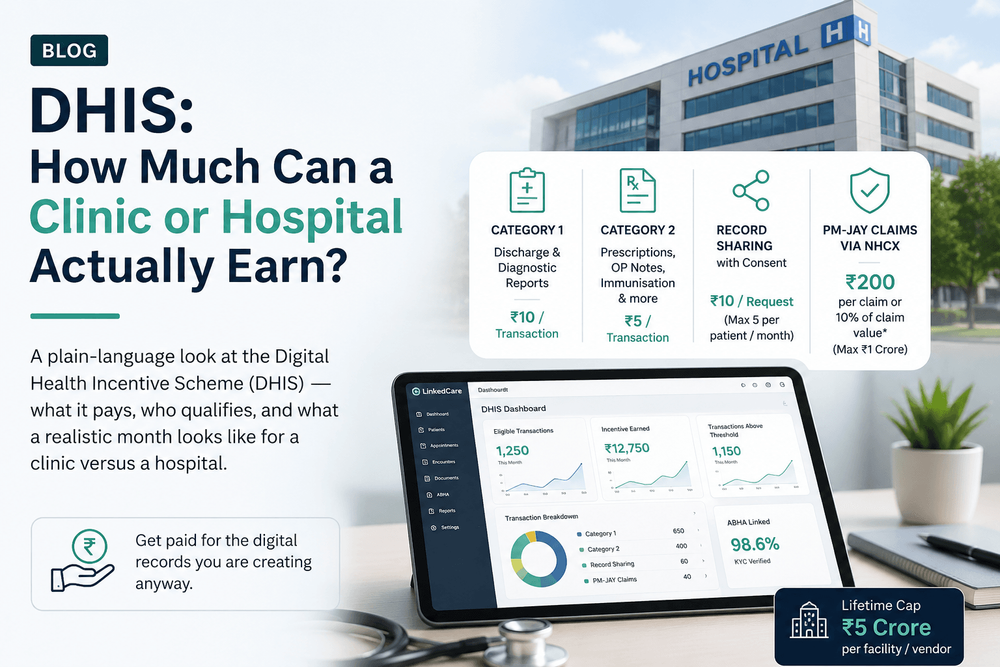
DHIS: How Much Can a Clinic or Hospital Actually Earn?
A practical guide to the National Health Authority’s Digital Health Incentive Scheme (DHIS) — eligible record types, monthly volume thresholds, realistic clinical payout benchmarks, and compliance rules.
DHIS subsidizes operational adoption by paying healthcare facilities for ABDM-linked health records.
Ayushman Bharat Digital Mission (ABDM) compliance is often viewed as an operational expenditure: staff training, software integration, and workflow adjustments. However, the Digital Health Incentive Scheme (DHIS), administered by the National Health Authority (NHA), reimburses hospitals, nursing homes, diagnostic labs, and clinics for generating verified digital health records.
What the Digital Health Incentive Scheme Actually Is
Launched by the NHA, DHIS incentivizes adoption across the healthcare sector through successive administrative updates. Corrigendum 7 governs operational parameters from April through September 2026. Because DHIS operates on funded budgetary renewal windows, facilities should consider payouts as an operational subsidy that offsets digitization costs rather than a permanent revenue entitlement.
Crucially, previous scheme restrictions requiring a minimum of 10 beds have been removed. Today, DHIS applies directly to all registered public and private healthcare entities, allowing single-doctor practices, standalone clinics, and large multi-specialty centers to participate equally.
How DHIS Payment Mechanics Work
The incentive operates on specific monthly baselines and verified record tiers:
The 100-Transaction Monthly Threshold: The first 100 qualifying transactions generated by your facility each calendar month earn ₹0. The threshold resets at the beginning of each billing month.
Incentives apply starting from the 101st transaction each month. Only KYC-verified ABHA records qualify.
Beyond the baseline threshold, transactions earn payouts based on clinical classification. To qualify, records must be linked to a fully KYC-verified ABHA profile:
| Clinical Record Type | Category | Incentive Rate |
|---|---|---|
| Inpatient Discharge Summaries & Diagnostic Reports | Category 1 | ₹10 per transaction |
| Prescriptions, OPD Consultation Notes, Immunization Logs | Category 2 | ₹5 per transaction |
| Consent-Based Record Requests (Health Information User - HIU) | Exchange | ₹10 per request (capped: 1/patient/day, 5/patient/month) |
| Consent-Based Record Transfers (Health Information Provider - HIP) | Exchange | ₹5 per transaction |
| PM-JAY Claims via NHCX (Structured FHIR Formats) | Claims | ₹200 or 10% of claim value, whichever is lower (capped at ₹1 Cr/facility) |
Cumulative Cap: The maximum lifetime incentive accessible by any single healthcare facility under DHIS is capped at ₹5 Crore.
Realistic Monthly Earnings Benchmarks
Payouts reflect clinical throughput and documentation discipline:
For independent single-doctor clinics, DHIS acts as an operational offset that covers monthly software expenses. For high-volume multi-specialty hospitals and pathology networks processing thousands of patients, it accumulates into significant non-operational recovery.
Prerequisites to Claim DHIS Payouts
Facilities must satisfy three mandatory operational requirements to claim financial disbursements:
- Verified HFR Registration: An active Health Facility Registry identifier linked on the official portal.
- KYC-Linked ABHA Records: Records must bind to an authenticated ABHA profile at the front desk rather than unlinked registration entries.
- Certified Software with Current API Compliance: Your HMIS/EMR provider must integrate with the latest ABDM API version and maintain active Web Application Security Assessment (WASA) certification.
Vendor API Compliance Notice: Facilities utilizing uncertified software or legacy API configurations become ineligible for disbursements regardless of patient intake volume. Ensuring your HMIS vendor stays updated with NHA standards is critical.
Automating DHIS Incentive Claims with LinkedCare
Because DHIS rewards compliant digital documentation, software automation is essential. In LinkedCare, ABHA registration, OTP verification, and FHIR R4 schema formatting happen in the background of everyday clinical care:
- Instant ABHA Linking: Front-desk counters capture and verify patient profiles within the core registration screen in seconds.
- Automated KYC Classification: Discharge summaries, diagnostic investigations, and e-prescriptions auto-tag into valid DHIS categories.
- Continuous API Compliance: LinkedCare maintains alignment with current NHA API standards and security certifications, ensuring your facility remains eligible without manual IT intervention.
Frequently Asked Questions
Do I need to apply for DHIS separately from ABDM registration?
Does DHIS still exist in 2026?
Can a small clinic earn meaningfully from the scheme?
What records count as an eligible transaction under DHIS?
Is the incentive credited automatically or claimed monthly?
Calculate Your Facility's DHIS Incentive Potential
Assess your monthly patient volume and see how LinkedCare automates KYC record compliance and exchange workflows.
Schedule a WalkthroughDisclaimer: This guide reflects the Digital Health Incentive Scheme parameters under Corrigendum 7 (effective April–September 2026). Incentive structures, rates, and operational eligibility are revised by National Health Authority notifications. Confirm current circulars directly at abdm.gov.in/dhis.