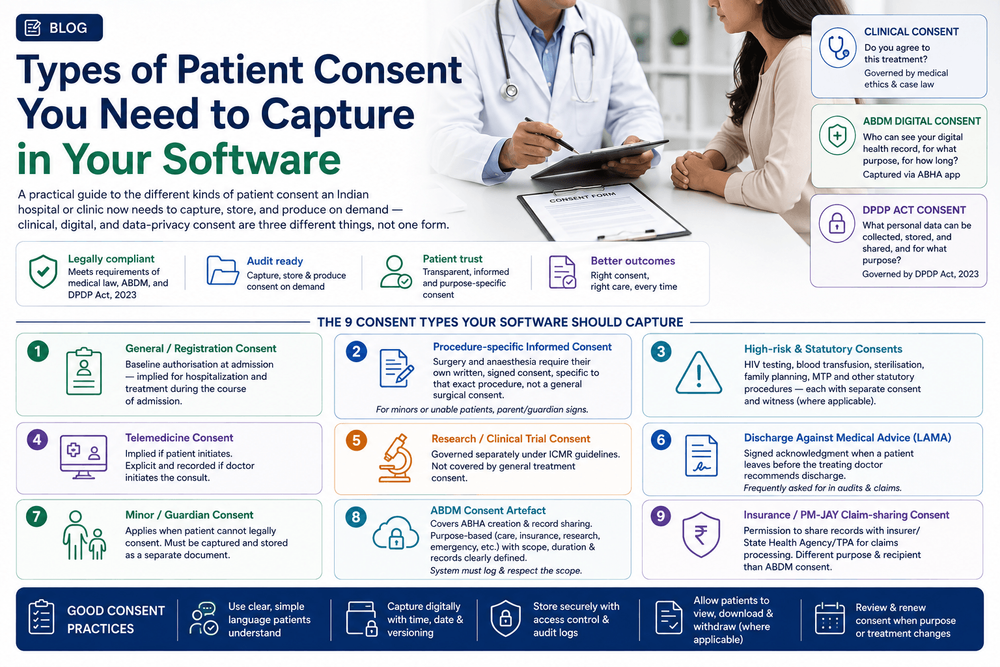
Types of Patient Consent You Need to Capture in Your Software
A practical guide for Indian hospitals and clinics on managing clinical treatment consent, ABDM digital record-sharing consent artefacts, and DPDP Act data-processing agreements.
Three distinct statutory frameworks require separate consent categories rather than a single blanket form.
Historically, informed consent across Indian healthcare involved signing a physical form prior to surgery and archiving it in a paper folder. Today, healthcare facilities operating digital systems must manage three legally distinct consent classifications simultaneously: clinical treatment authorization, ABDM health data exchange permissions, and DPDP Act personal data processing agreements.
Three Different Consents, Three Different Regulatory Frameworks
Clinical Consent
Authorizes medical examination and intervention. Governed by medical ethics and landmark jurisprudence (e.g., Samira Kohli v. Dr. Prabha Manchanda), establishing that consent must be specific, informed, and uncoerced.
ABDM Digital Consent
Governs access, sharing duration, and purpose of digital health records. Initiated securely through the patient's ABHA ecosystem—producing cryptographic consent artefacts managed via software APIs.
DPDP Act Consent
Regulates internal collection, storage, and processing of personal and sensitive medical data under the Digital Personal Data Protection Act, 2023. Explicitly independent of clinical care agreements.
Relying on a single line item at the bottom of a general admission form to satisfy all three standards introduces severe compliance vulnerability under modern data protection scrutiny.
The 10 Specific Consent Types Your Software Should Capture
What Digital Consent Capture Means in Practice
Operational compliance requires every consent category to exist within the patient electronic health record (EHR) as an authenticated e-signature or verified scan. Records must be timestamped, bound to specific clinical encounters, and linked to official Consent Manager artifact IDs where applicable. This digital trail satisfies audits by NABH inspectors, PM-JAY investigators, and DPDP regulatory officers.
Verbal assurances or unverified checkboxes fail to satisfy legal verification standards across all three regulatory domains.
How LinkedCare Manages Multi-Layered Consent
LinkedCare integrates consent workflows directly into the point-of-care journey rather than relying on disparate paperwork. Clinical consent forms, ABDM consent requests, and DPDP data-processing agreements are captured natively within regular patient pathways—timestamped, encounter-linked, and individually retrievable for transparent auditing.
Frequently Asked Questions
Is verbal consent ever legally sufficient in healthcare?
Do I need separate consent to share a patient record for PM-JAY claims?
What happens if a patient revokes ABDM consent?
Is DPDP consent distinct from ABDM consent?
Streamline Multi-Layered Consent in Your Practice
Discover how LinkedCare captures clinical, ABDM, and DPDP consents natively within secure patient workflows.
Schedule a Compliance DemoDisclaimer: This guide provides general informational content and does not constitute formal legal advice. Regulatory compliance requirements span medical ethics codes, NABH standards, ABDM frameworks, and the DPDP Act. Always verify operational mandates with qualified legal counsel and relevant statutory authorities.