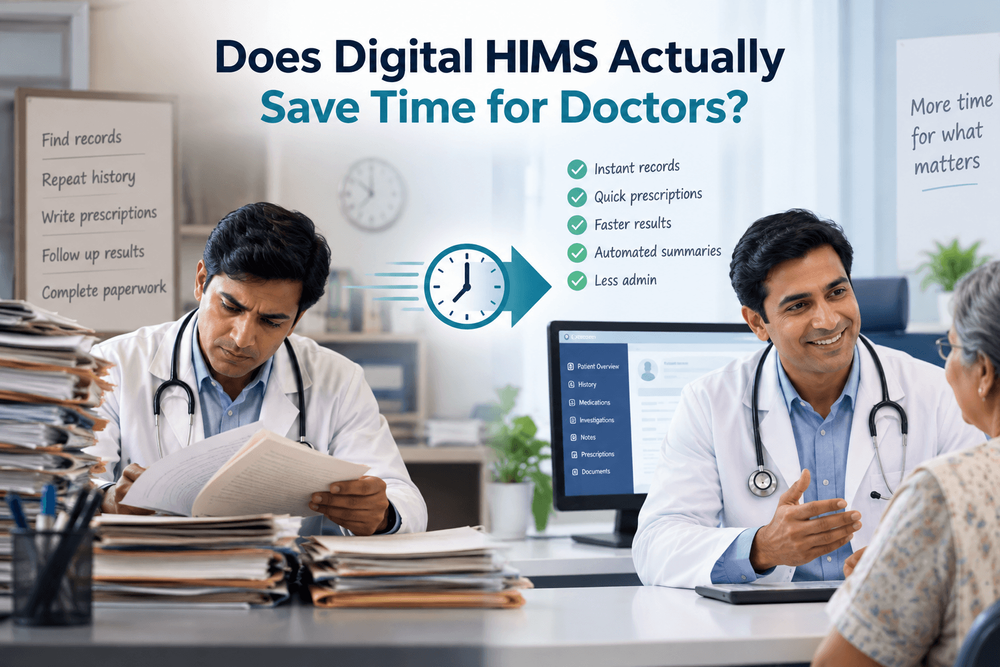
An honest look at where a hospital information management system gives a doctor time back, where it takes time away, and what separates the two
Three different effects, usually reported as one number.
Almost every HIMS sales conversation contains the claim that the system will save doctors time. Almost every doctor who has used one has a story about the opposite. Both are describing something real. A HIMS changes three things at once — it removes some work, it creates some new work, and it shifts other work from one person to another — and whether a doctor experiences that as time saved depends almost entirely on how the system was configured, not on whether it was installed.
Time Genuinely Removed
Finding a file, waiting for a file, re-taking a history that was already taken, rewriting the same medication list at every visit, physically walking a request to a department. This work disappears when records are digital and shared. It is real, and for most doctors it is the largest single gain.
Time Genuinely Added
Structured data entry that paper never demanded. Coded diagnosis fields, mandatory forms, dropdowns instead of a line of handwriting. Some of this is worth it — it is what makes the record searchable, claimable and auditable later — but it is a cost, and pretending otherwise is why so many deployments lose clinical goodwill in month two.
Time Moved, Not Saved
A great deal of what gets called "efficiency" is work relocated: from the doctor to the front desk, from the nurse to the system, from the end of the month to the moment of care. This is often the right decision. It is not the same as the work vanishing, and it should not be sold as such.
International time-motion research is blunt about the middle category. A widely cited 2016 study of US ambulatory practice found physicians spending roughly two hours on EHR and desk work for every hour of direct patient care, with just over a quarter of the office day in direct clinical face time. Those figures come from a different health system with different documentation and billing demands than India's, so they do not transfer directly — but they establish the point that a digital record is not automatically a lighter one.
Where the minutes actually come from
Record retrieval
The clearest win, and the least disputed. Pulling a returning patient's history from a physical file room is measured in minutes; pulling it from a well-built record is measured in seconds. In a multi-location practice or a hospital where the patient last visited a different department, paper retrieval often fails entirely and the history simply gets re-taken.
Repeat history-taking
Every re-asked allergy question, every re-listed chronic medication, every "when did this start" that a previous consultation already answered. This is invisible time — it is spent inside the consultation, so it never shows up on anyone's efficiency report — and it is one of the biggest recoverable blocks in an OPD day.
Prescription writing
Templates, favourites, and previous-prescription carry-forward turn a two-minute handwritten prescription into a twenty-second one for the large share of visits that are follow-ups on a stable regimen. This is where per-visit savings compound fastest in high-volume OPD.
Order placement and result chasing
A lab or radiology order that reaches the department instantly, and a result that returns to the doctor's screen instead of a tray, removes both the walk and the wait. The doctor stops being the person who follows up on whether a report came back.
Documentation during the consultation
This is where time is usually added, not saved, and where most systems lose doctors. If the doctor is typing while the patient is talking, the system has moved clerical work into the consultation. Voice input, scribe-style capture, templated notes and sensible defaults are what determine whether this line is a cost or roughly neutral.
Discharge summaries
A summary assembled from data already in the record — diagnoses, procedures, medications, investigations — instead of written from scratch at the end of a shift. For inpatient-heavy specialities, this is frequently the single largest time recovery in the whole system, and it is the one doctors notice most.
Claim and TPA documentation
PM-JAY and insurance paperwork is not clinical work, but it lands on clinicians constantly in the form of queries, missing documentation, and re-submissions. When the record is complete and structured at the point of care, the number of times a claim comes back to the treating doctor drops sharply.
NABH and audit preparation
Paper hospitals prepare for audits in a burst of clinician time before the inspection. Digital hospitals with proper capture prepare continuously and invisibly. The saving is real but seasonal — it does not show up in a normal week.
Coordination and phone calls
"Has the patient been admitted." "Did radiology see this." "Is the bed ready." A shared live record removes a category of interruption that is rarely counted as clinical work but consumes a meaningful part of a consultant's day.
Login, navigation and system friction
The counterweight: Slow loading, too many clicks to reach a common action, repeated logins, screens designed for administrators rather than clinicians. Fifteen seconds of friction, thirty times a day, is more than ten minutes — and it is the cost that vendors are least willing to discuss and hospitals are least likely to measure.
What "saves time" actually means in practice
Concretely: a HIMS saves a doctor time when the record opens in under a few seconds, when the last three visits are visible without navigation, when a follow-up prescription can be issued from the previous one, when the discharge summary assembles itself from what was already entered, and when nothing on the screen demands data the doctor was not going to record anyway.
It costs a doctor time when structured fields are mandatory without being clinically useful, when the same information has to be entered in two places, when the interface was designed for billing rather than for care, and when the configuration was signed off by administration without a clinician in the room.
The Honest Summary: A HIMS is a lever, not a gift. The question worth asking a vendor is not "will this save my doctors time" but "show me which specific tasks disappear, which new ones appear, and who picks up the ones that move."
How LinkedCare Helps
LinkedCare is built around the assumption that the doctor's screen is the constraint. The patient's history, active medications, allergies and recent investigations are on the first screen rather than behind navigation; follow-up prescriptions carry forward from the previous visit; discharge summaries assemble from data already captured during the admission; and ABDM record sharing happens through the same workflow rather than as a parallel compliance task. Where new data entry is genuinely required — for claims, for NABH, for DPDP consent — it is placed with the person whose job it is, not defaulted onto the consultant.
Frequently Asked Questions
How long before doctors actually feel the time saving?
Expect the first four to six weeks to be net negative — the system is unfamiliar, templates are not yet built, and old and new processes run in parallel. Practices that build prescription templates and note templates during that window usually cross over into net positive within the second month. Practices that never build them often never cross over.
Does voice input or AI documentation change the picture?
It changes the largest cost line — in-consultation documentation. It does not change retrieval, orders, claims or coordination, which are workflow problems rather than typing problems. Treat it as one component of the answer, not the answer.
Is the time saving different for OPD versus inpatient care?
Yes, and materially. High-volume OPD gains most from retrieval, repeat history and prescription templates — many small savings across many patients. Inpatient care gains most from discharge summaries, order management and handover, where the savings are fewer but much larger each.
What if our doctors are already comfortable with paper?
Then the honest case is not speed. It is what paper cannot do at all: retrieval across locations, ABDM record sharing, claim documentation that survives an audit, and a history that does not depend on which folder was found. Arguing speed with a fast paper-based clinician is usually the wrong argument, and it is the one that most often loses.